Tank Manhole Cover Selection: Flanged vs Swing Type
Author:Zhengrong Time:2026-11-05 14:04:18 Number of views:81Second-rate
A tank manhole cover is the one part of a vessel that is opened on purpose, which is why it has to seal as reliably as a welded joint. Selection comes down to three questions: how often the tank is entered, what pressure or vacuum the vessel carries, and what the process medium does to the cover material. Answer those and the choice among a flanged cover, a swing type manhole and a carbon steel pressure cover usually settles itself.
What a Tank Manhole Cover Has to Do
A manhole cover is an access closure, not a lid. It sits on a nozzle or a reinforced opening in the shell, and together with its gasket and bolting it becomes part of the pressure boundary. That single fact drives most of the specification: the cover has to carry the same design pressure as the vessel, hold a seal across the full temperature range, and still be openable by maintenance staff under the conditions the plant actually works in.
Two failure modes matter. The first is a joint leak, caused by insufficient or uneven bolt load, a gasket that does not suit the medium, or a sealing surface damaged during an earlier opening. The second is mechanical wear: hinge pins that stiffen, swing bolts that gall, sealing faces that get scratched because the cover was dragged rather than lifted. A cover that is awkward to handle will be handled badly, and the seal suffers for it.
Access frequency is the variable most often underestimated at the specification stage. A cover opened once a year for internal inspection is a different product from one opened every shift for cleaning. The first can be a fully bolted flanged cover. The second needs hinges, quick-release hardware and a sealing surface that tolerates repeated contact without re-machining.
Flanged, Swing Type and Pressure Covers Compared
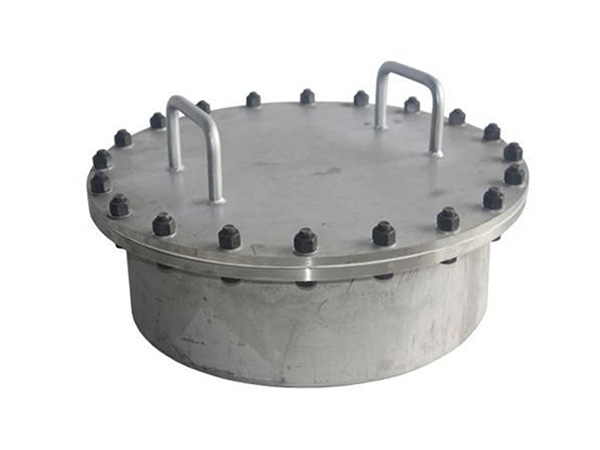
Across the manhole range, three constructions cover most vessel access duties. The flanged manhole cover bolts to a mating flange on the vessel nozzle. Because the load path runs through the flange and the bolt circle rather than through a clamp, the joint holds a uniform gasket compression and stays sealed under internal pressure and vacuum. Zhengrong builds this type from ASTM A240 304/304L or 316/316L stainless steel, with duplex 2205 and 2507 available, in sizes from DN300 (12 inch) to DN800 (32 inch) and larger on request. Pressure ratings run from PN6 through PN25, and ANSI 150 and ANSI 300 patterns are also produced. Flange drilling follows ASME B16.5, EN 1092-1, DIN 2633 or JIS B2220 depending on what the vessel nozzle uses.
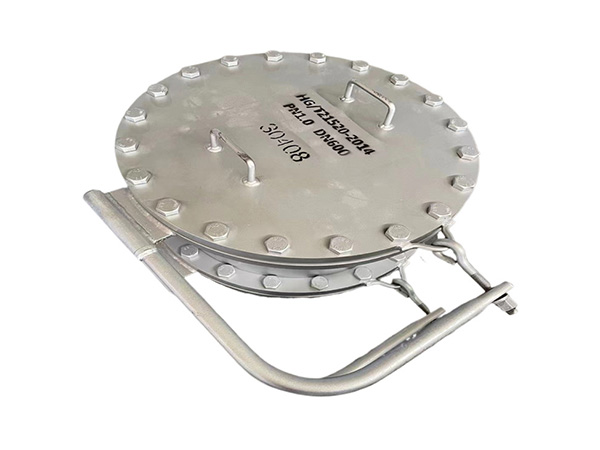
The swing type manhole carries its cover on heavy-duty hinges so the lid pivots open, typically up to 180 degrees, and rests against the shell instead of being lifted off and stored. Clamping is by quick-release clamps or swing bolts. External hinges are standard, and internal hinges are used where the cover has to sit flush. Standard sizes are DN300, DN400, DN450, DN500 and DN600, with ratings from atmospheric up to PN10, PN16 or ANSI 150. Sealing surfaces are supplied as raised face or flush and concave.
The carbon steel pressure manhole cover is the heavy-duty option for large vessels where corrosion resistance is not the governing requirement. It is fabricated from Q235B, ASTM A516 Gr. 60/70 or ASTM A234 WPB, in sizes from DN300 to DN600 plus custom sizes, with ratings from PN6 to PN25 and ANSI 150 to ANSI 300. Flange drilling covers ASME B16.5, HG/T 21515, DIN 2633 and JIS B2220. Surfaces are normally protected with red oil, black paint, galvanizing or epoxy coating.
The practical differences between the three come down to this:
Opening method: full bolt circle on the flanged cover; hinges plus clamps or swing bolts on the swing type; heavy bolting or swing bolts on the carbon pressure cover.
Pressure capability: the flanged stainless cover spans PN6 to PN25 and ANSI 150/300, including vacuum service; the swing type runs from atmospheric to PN10, PN16 or ANSI 150; the carbon cover reaches PN25 and ANSI 300.
Typical material: 304/304L, 316/316L and duplex 2205/2507 for the flanged cover; 304/304L, 316/316L or duplex 2205 for the swing type; Q235B, A516 Gr. 60/70 or A234 WPB for the carbon cover.
Handling effort: lowest on the swing type, where the lid stays attached; highest on a large bolted cover that has to be lifted clear.
Surface finish: mill finish, polished to Ra not more than 0.8 micrometre, or mirror finish to Ra not more than 0.4 micrometre on the stainless covers; coating systems on the carbon cover.
Best fit: frequent entry and hygiene on the swing type; pressure, vacuum and aggressive media on the flanged cover; large, cost-sensitive, non-aggressive service on the carbon cover.
Matching the Cover to the Duty
Most projects fall into one of two patterns, and it helps to name them before opening a catalogue.
Case A, frequent entry at low or moderate pressure. Brewing tanks, mixing vessels, water treatment tanks and food processing equipment are opened for cleaning on a routine schedule, and the medium is not aggressive enough to demand a fully bolted closure. A swing type manhole is the natural choice: the hinged lid removes the lifting hazard, quick-release clamps cut opening time, and a polished or mirror sealing surface keeps cleaning straightforward. Specify the gasket for the cleaning chemicals as well as the process, because caustic and acid wash cycles attack different elastomers.
Case B, pressure, vacuum or aggressive chemistry with infrequent entry. Reactors, separators, steam drums and solvent storage are opened rarely, and the joint has to hold a seal for long periods without attention. Here the flanged stainless cover is the safer specification: the bolted flange gives an even gasket load, the design tolerates vacuum, and 316L or duplex grades handle chlorides and acidic media that would attack a carbon cover. Where internal cleanliness is part of the product specification, a polished or mirror finish is available instead of mill finish.
A third pattern sits between them: large carbon steel storage tanks, often outdoors, where the medium is benign and cost drives the decision. The carbon steel pressure cover fits that service, provided the coating system is specified for the local atmosphere and the flange face is protected during transport and storage.
The awkward cases deserve deliberate thought. Frequent access plus pressure is not a contradiction, because the swing type is rated to PN16 or ANSI 150 in the sizes listed above. Frequent access plus vacuum, or frequent access plus an aggressive solvent, pushes the decision back toward a flanged cover, possibly with a smaller, lighter cover for the routine entry and a separate inspection opening.
Sizes, Pressure Classes and Flange Standards
Size is set by what has to pass through the opening, not by the cover alone. A DN300 (12 inch) opening is the smallest in the flanged and carbon ranges and is adequate for inspection and cleaning access on smaller vessels. DN500 and DN600 are common where a person or bulky tooling has to enter. The flanged stainless range extends to DN800 (32 inch) and beyond on request, and the carbon cover is built to DN600 as standard with custom sizes available.
Pressure class has to be read together with temperature, because a PN16 rating at ambient is not a PN16 rating at elevated temperature. The cover, gasket and bolting are one assembly, and the lowest-rated element governs the joint. When the vessel nozzle is drilled to one standard and the cover to another, the bolt holes will not line up, and the usual field fix, reaming or slotting, damages the flange. Confirm the drilling standard, bolt count, bolt circle diameter and facing type before ordering. The ASME codes and standards library is the practical place to confirm the current edition of B16.5 and the flange dimensional data that goes with it.
Where the vessel falls under a pressure systems regime, the closure is part of the written scheme of examination and cannot be substituted informally. In the UK, the Pressure Systems Safety Regulations guidance sets out those duties, and HSE guidance L122 explains how the examination regime is applied in practice. On the piping side, the design references are collected on the ASME B31.3 process piping page.
Material, Finish and Gasket Selection
Stainless covers are specified as 304/304L for general service and 316/316L where chlorides, acids or coastal atmospheres are present. Duplex 2205 and 2507 are available where higher strength and stress corrosion resistance are needed. The grade should be chosen against the process medium and the cleaning regime together, because a steel that resists the product may still suffer from the wash-down chemicals.
Carbon steel covers, in Q235B, ASTM A516 Gr. 60/70 or ASTM A234 WPB, rely on their coating for corrosion protection. Red oil and black paint are shop protections suited to indoor storage and dry service; galvanizing and epoxy coating are the options for outdoor or humid installations. Coating damage at the flange face is a common source of early corrosion, so the face is normally masked during coating and re-protected after bolting.
Finish on stainless covers ranges from mill to polished and mirror. A polished finish is a hygiene requirement, not a corrosion one, and specifying it where it is not needed adds cost without adding life. Gaskets are the other half of the seal. EPDM, NBR, silicone, FPM (Viton) and PTFE are available for the stainless covers, while the carbon cover accepts asbestos-free rubber, graphite, PTFE and spiral wound gaskets. The selection logic for these materials, including temperature and media limits, is set out in the gasket selection guide for industrial flanges.
Documentation matters as much as the part. Material verification, dimensional inspection of the flange face and pressure testing sit inside the production route, and covers can be supplied with EN 10204 3.1 mill test certificates for traceability against ASME, PED 2014/68/EU and other project requirements.
What to Include in a Manhole Cover Inquiry
An inquiry that lists the following gets a usable quotation on the first pass. One that says only "manhole cover, stainless" gets a round of questions instead.
Vessel type, shell material, design pressure and vacuum, and design temperature.
Required opening size in DN or inches, and the clear opening needed for access or tooling.
Cover type preference, flanged, swing type or carbon pressure cover, or the service conditions if the type is still open.
Flange drilling standard, bolt count, bolt circle and facing type of the mating nozzle flange.
Material grade, including any duplex requirement, plus the process medium and its concentration.
Surface finish, mill, polished or mirror, and the coating system for carbon steel.
Gasket material, and whether bolting is in scope.
Documentation: mill test certificates, pressure test records, third-party inspection, and any declaration required under PED or another regime.
Drawings help more than descriptions. A sketch of the nozzle with its flange detail removes almost all of the ambiguity around bolt pattern and facing.
Common Selection and Installation Mistakes
Ordering by size alone. Two DN500 covers with different drilling standards are not interchangeable, and the error only appears at installation.
Ignoring vacuum. A cover selected for internal pressure is not automatically suitable for vacuum. The gasket and the cover stiffness both matter, and the requirement has to be stated.
Mismatching facings. A raised face cover bolted to a flat face nozzle will not seat correctly, and the joint leaks regardless of bolt torque.
Reusing the old gasket. A compressed gasket does not recover. Refitting one after an inspection is one of the most common causes of a leak on restart.
Tightening in a circle. Bolts taken up sequentially around the circle load one side of the joint first. A cross pattern in stages gives even gasket compression and is what the joint was designed for.
Choosing the hinge orientation on the drawing. The swing direction has to clear insulation, ladders, nozzles and the platform edge. A cover that swings into a handrail is a cover that gets left unlatched.
Coating the flange face. Paint on a sealing surface adds an uncontrolled layer between gasket and metal. Mask the face, coat the rest, and touch up the edges afterwards.
Frequently Asked Questions
What size manhole cover does a storage tank need?
Size is set by the access requirement and the vessel design rather than by a single rule. For inspection and cleaning access, DN300 (12 inch) is the smallest size in the flanged and carbon ranges, and DN500 or DN600 is typical where a person or bulky equipment has to pass.
Can a swing type manhole hold pressure?
Yes, within its rating. The swing type is supplied from atmospheric up to PN10, PN16 or ANSI 150 in the standard sizes from DN300 to DN600, with quick-release clamps or swing bolts providing the clamping load. Above that range, or where vacuum is involved, a flanged cover is the correct specification.
Which gasket should be used with a stainless manhole cover?
It depends on the medium, the temperature and the cleaning chemicals. EPDM, NBR, silicone, FPM (Viton) and PTFE are available. EPDM suits water and many dilute chemicals but not oils, NBR suits oils and fuels, and PTFE or FPM are used for aggressive media and higher temperatures. State the medium and temperature in the inquiry so the gasket can be matched.
Are manhole covers supplied with test certificates?
They can be. Covers are supplied with EN 10204 3.1 mill test certificates on request, alongside dimensional inspection records for the flange face and pressure test records. Where the vessel falls under PED 2014/68/EU or another regime, state the required documentation in the inquiry so it is included in the quotation.
Conclusion
The cover type follows from two facts about the vessel: how often it is opened, and what the joint has to hold. Frequent access at moderate pressure points to a swing type manhole. Pressure, vacuum or aggressive chemistry points to a flanged stainless cover. Large, benign, cost-sensitive service points to a carbon steel pressure cover. Everything after that, size, class, drilling standard, facing, grade, finish and gasket, has to be written down, because none of it can be assumed at installation. Settle the closure at the specification stage and the manhole stops being the part of the vessel that leaks.
References
ASME B16.5, Pipe Flanges and Flanged Fittings: NPS 1/2 through NPS 24, American Society of Mechanical Engineers.
ASME B31.3, Process Piping, American Society of Mechanical Engineers.
EN 1092-1, Flanges and their joints. Circular flanges for pipes, valves, fittings and accessories, PN designated. Part 1: Steel flanges.
ASTM A240/A240M, Standard Specification for Chromium and Chromium-Nickel Stainless Steel Plate, Sheet, and Strip for Pressure Vessels and for General Applications.
ASTM A516/A516M, Standard Specification for Pressure Vessel Plates, Carbon Steel, for Moderate- and Lower-Temperature Service.
Directive 2014/68/EU on pressure equipment, Official Journal of the European Union.
HSE, Safety of Pressure Systems. Pressure Systems Safety Regulations 2000, Approved Code of Practice and Guidance L122.