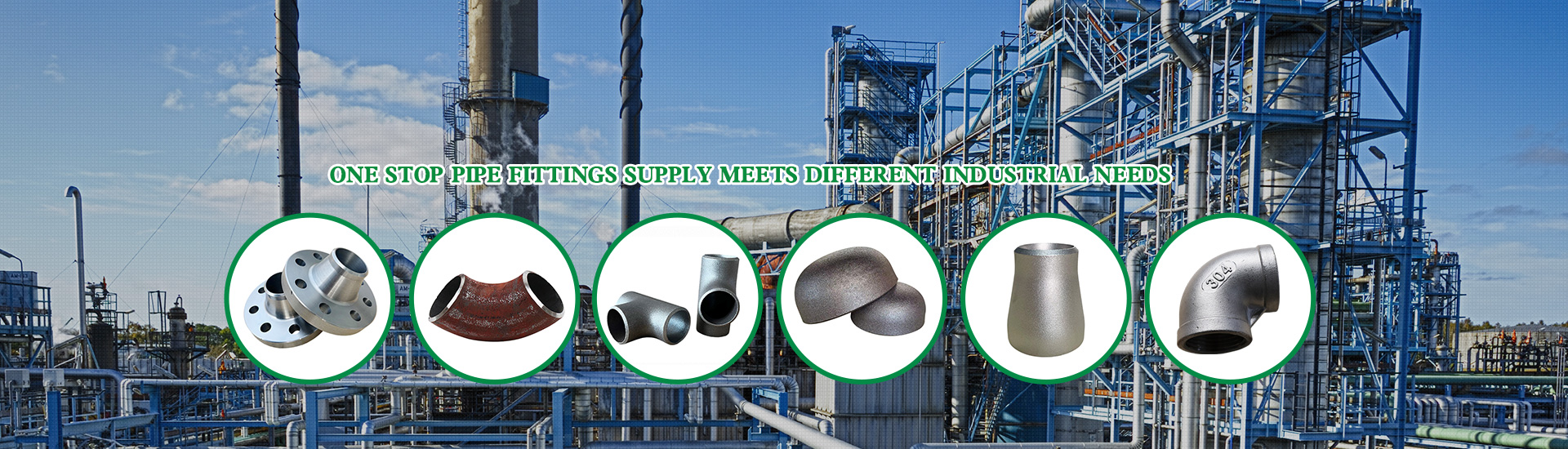
Welding carbon steel pipe fittings is a critical process in industrial piping systems such as oil & gas, petrochemical plants, power stations, and water treatment facilities. To ensure safety, reliability, and long service life, welding must follow strict international standards covering procedures, material selection, inspection, and quality control.
1. Key Welding Standards for Carbon Steel Pipe Fittings
Several international codes govern welding practices for carbon steel pipe fittings:
ASME B31.3 – Process Piping
Most widely used standard in industrial plants
Covers design, fabrication, inspection, and testing
Defines allowable stress and welding requirements
ASME B31.1 – Power Piping
ASME Section IX – Welding Qualifications
Governs welding procedure specifications (WPS)
Requires welder performance qualification (WPQ)
Ensures welders are certified for specific materials and processes
2. Pipe Fitting Welding Standards (ASME B16 Series)
ASME B16.9 – Buttwelding Fittings
Covers elbows, tees, reducers, and caps
Defines dimensional tolerances and manufacturing requirements
Ensures compatibility in welded pipeline systems
ASME B16.25 – Butt-Welding Ends
Specifies end preparation for welding
Includes bevel angles and root face requirements
Ensures proper weld penetration and alignment
3. Material Standards for Carbon Steel Pipe Fittings
Welding quality depends heavily on material compliance.
Common Materials
ASTM A234 WPB (most common carbon steel fitting)
ASTM A105 (for forged fittings and flanges)
ASTM A106 (for seamless pipe integration systems)
Requirements
Controlled carbon content for weldability
Mechanical strength consistency
Proper heat treatment when required
4. Welding Processes Used in Pipe Fittings
Different welding methods are used depending on application and thickness.
Common Processes
SMAW (Shielded Metal Arc Welding) – most common in field work
GTAW (TIG Welding) – used for root passes and precision welding
GMAW (MIG Welding) – used in fabrication shops
SAW (Submerged Arc Welding) – used for heavy-wall pipes
5. Welding Procedure Specification (WPS)
A WPS is mandatory for all industrial welding work.
WPS Includes
Welding process type
Base material specification
Filler material selection
Preheat and post-weld heat treatment (PWHT)
Welding position and technique
Purpose
Ensures consistent weld quality across all joints.
6. Pre-Welding Requirements
Proper preparation is essential before welding begins.
Key Steps
Cleaning pipe ends (remove oil, rust, and moisture)
Proper beveling according to ASME B16.25
Alignment and fit-up control
Tack welding to maintain position
Importance
Poor preparation leads to defects like lack of fusion or cracks.
7. Preheating and Post Weld Heat Treatment (PWHT)
Heat treatment improves weld integrity.
Preheating
PWHT
8. Welding Inspection Standards
Quality control is mandatory in all industrial welding.
Visual Inspection (VT)
Non-Destructive Testing (NDT)
Radiographic Testing (RT) – internal defects
Ultrasonic Testing (UT) – crack detection
Magnetic Particle Testing (MT) – surface cracks
Dye Penetrant Testing (PT) – surface flaw detection
9. Pressure Testing After Welding
After welding, system integrity must be verified.
Methods
Purpose
10. Common Welding Defects in Carbon Steel Fittings
Typical Defects
Prevention
11. Safety Requirements in Welding Operations
Safety Measures
Use proper PPE (helmet, gloves, protective clothing)
Ensure ventilation in confined spaces
Follow hot work permit systems
Prevent fire hazards in industrial environments
Conclusion
Welding carbon steel pipe fittings requires strict adherence to international standards such as ASME B31.3, ASME Section IX, and ASME B16.9. Proper welding procedures, qualified personnel, correct material selection, and thorough inspection are essential to ensure safe, durable, and leak-free pipeline systems. Following these standards significantly improves system reliability and extends service life in industrial applications.
References
ASME B31.3 – Process Piping
ASME B31.1 – Power Piping
ASME Section IX – Welding and Brazing Qualifications
ASME B16.9 – Factory-Made Wrought Buttwelding Fittings
ASME B16.25 – Butt-Welding Ends
API 1104 – Welding of Pipelines and Related Facilities