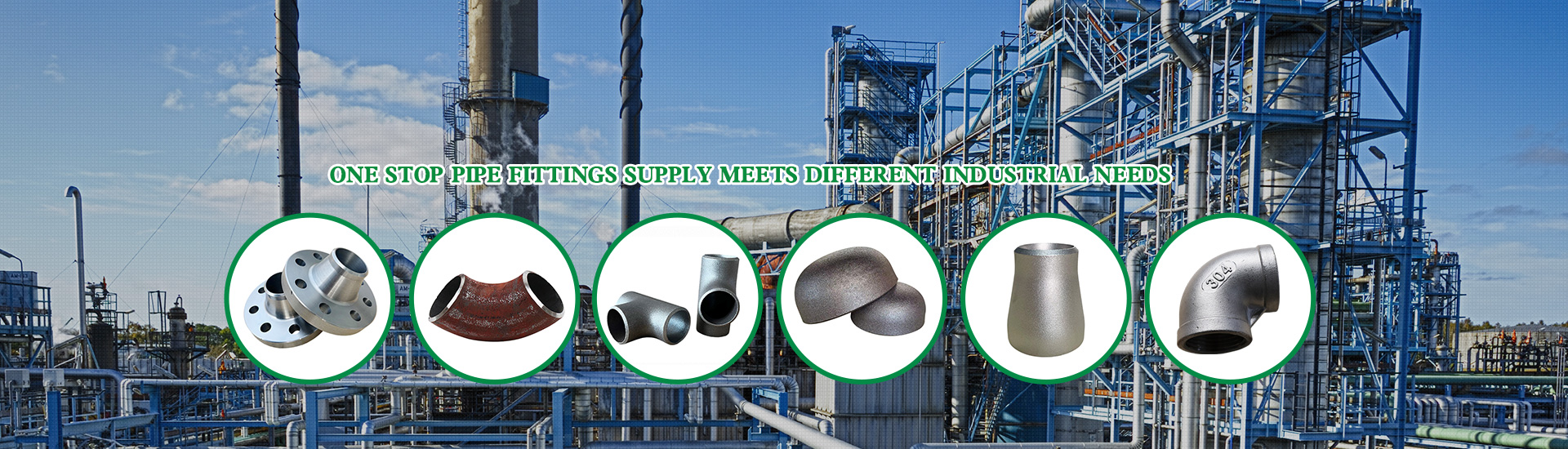
Industrial pipe fittings are essential components used to change direction, connect, branch, or terminate piping systems. Their manufacturing process must ensure high strength, dimensional accuracy, and reliable sealing performance, especially for high-pressure and corrosive environments. Depending on material and product type, pipe fittings are produced through forging, casting, welding, or fabrication processes.
1. Raw Material Selection
The manufacturing process begins with selecting high-quality raw materials.
Common Materials
Carbon steel (ASTM A105, A234 WPB)
Stainless steel (ASTM A182 F304/F316)
Alloy steel (Cr-Mo grades like P11, P22)
Ductile iron or cast iron (for low-pressure systems)
Key Requirements
Chemical composition compliance
Mechanical strength verification
Material certification (MTC)
2. Cutting and Preparation
Raw materials are cut into required sizes before forming.
Process Steps
Cutting steel bars, billets, or pipes
Removing surface defects
Preparing blanks for forging or machining
Importance
Accurate cutting ensures dimensional consistency in later stages.
3. Forging or Forming Process
Forging is widely used for high-pressure fittings.
Forging Method
Advantages
Alternative Methods
4. Casting Process (For Complex Shapes)
Casting is used for fittings with complex geometry.
Process Steps
Molten metal poured into molds
Solidification and cooling
Mold removal and cleaning
Advantages
Limitations
5. Machining Process
After forming, precision machining ensures correct dimensions.
Operations Include
Purpose
6. Heat Treatment
Heat treatment improves mechanical properties.
Common Processes
Normalizing
Annealing
Quenching and tempering
Benefits
7. Surface Treatment and Cleaning
Surface treatment protects fittings from corrosion.
Methods
Purpose
8. Welding (for Welded Fittings)
Some fittings require welding during manufacturing.
Types
Butt welding
Socket welding
Requirements
Qualified welding procedures (WPS)
Skilled welders (certified)
Post-weld heat treatment (if required)
9. Non-Destructive Testing (NDT)
NDT ensures internal and external quality without damaging the product.
Methods
Ultrasonic testing (UT)
Radiographic testing (RT)
Magnetic particle testing (MT)
Dye penetrant testing (PT)
Purpose
Detect cracks, voids, and weld defects
Ensure structural integrity
10. Dimensional Inspection
Every fitting must meet strict dimensional tolerances.
Tools Used
Key Checks
Outer diameter
Wall thickness
Angle (for elbows)
Thread accuracy
11. Pressure Testing
Pressure testing verifies performance under working conditions.
Types
Hydrostatic testing
Pneumatic testing
Purpose
12. Marking and Identification
Finished products are marked for traceability.
Information Includes
Material grade
Size and pressure class
Heat number
Manufacturer logo
13. Packaging and Storage
Proper packaging prevents damage during transport.
Methods
Wooden crates
Plastic caps for ends
Anti-rust oil coating
Waterproof wrapping
Conclusion
The manufacturing of industrial pipe fittings involves multiple critical stages including material selection, forging or casting, machining, heat treatment, surface finishing, inspection, and testing. Each step plays an important role in ensuring strength, dimensional accuracy, and long-term performance. Strict quality control throughout the process guarantees safe and reliable operation in industrial piping systems.
References
ASME B16.9 – Factory-Made Wrought Buttwelding Fittings
ASTM A234 – Pipe Fittings of Wrought Carbon Steel
ASTM A182 – Forged Stainless Steel Fittings and Flanges
ASME B31.3 – Process Piping
API 570 – Piping Inspection Code
ISO 9001 – Quality Management Systems in Manufacturing